Introduction 1.2
Completion requirements
Additional material to topic 1
BI Frameworks and Architectures
BI Framework
- A conceptual model that shows how BI components interact to transform data into insights. It is a comprehensive system of processes, technologies, people, and policies that enable an organization to collect, store, analyze, and present business data to derive actionable insights for better, data-driven decision-making
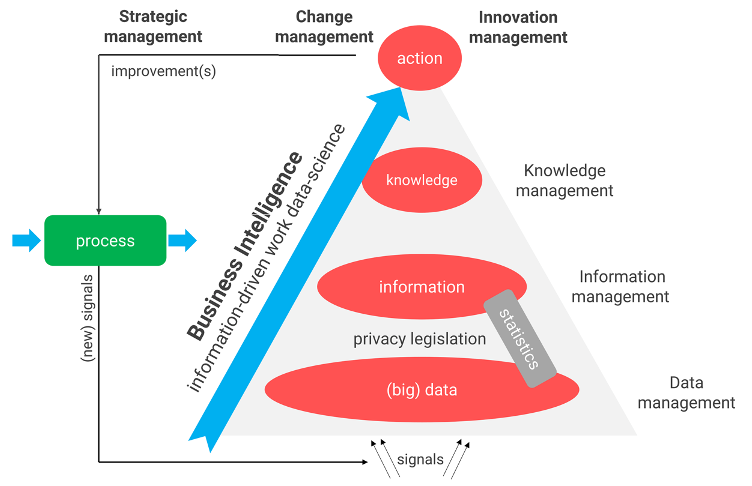
Forms of BI Frameworks
- Reporting: review of what has happened and make broad adjustments
- Dashboards: track the most important KPIs on BI dashboards
- Data analysis or data discovery: analyse the data from different angles and find new insights
- Data mining: use algorithms do the analysis (semi) automatically
- Predictive analytics: train an algorithm to make predictions
- Machine learning: create a neural network that makes decisions
- Signalling: alerts signal when to take action
- Data visualization: communicate the data in a format that appeals to the user
BI Framework Key Components
- Data Sources
- Internal: Transactional databases, ERP, CRM.
- External: Social media, market research, IoT.
- ETL (Extract, Transform, Load)
- Extracts data from heterogeneous sources.
- Cleans, transforms, integrates.
- Loads into data warehouse
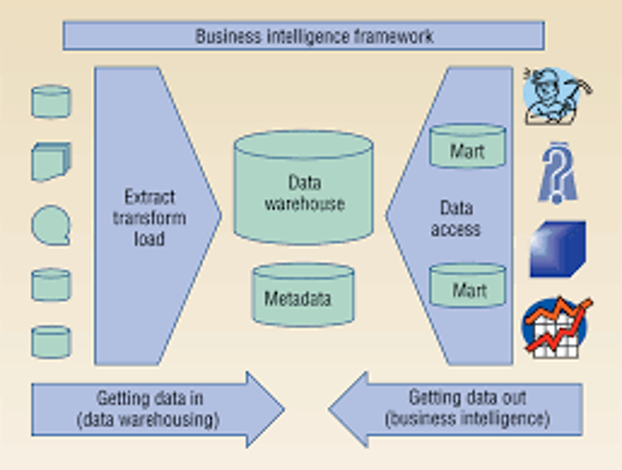
- · Data Warehouse (DW)
o Central repository of structured, historical data.
o Supports OLAP (Online Analytical Processing).
- · Data Marts
o Subset of DW, focused on specific departments (e.g., Sales, HR).
- · Analytics Layer
o OLAP cubes, Data Mining, Machine Learning models.
o Predictive, prescriptive, and descriptive analytics.
- Data Warehouse (DW)
- Central repository of structured, historical data.
- Supports OLAP (Online Analytical Processing).
- Data Marts
- Subset of DW, focused on specific departments (e.g., Sales, HR).
- Analytics Layer
- OLAP cubes, Data Mining, Machine Learning models.
- Predictive, prescriptive, and descriptive analytics.
- Analytics Layer
- OLAP cubes, Data Mining, Machine Learning models.
- Predictive, prescriptive, and descriptive analytics.
- Presentation Layer
- Dashboards, scorecards, reports, and visualization tools.
- Provides insights to managers and executives.
- Metadata Layer
- Stores information about data (origin, meaning, structure).
- Ensures data governance and consistency.